Please take a moment, after looking at this information, to visit the Home Page of my Stained Glass and Woodworking site via the link at the bottom. You may see something you like.
In North Carolina many new communities are built on old farmland. Most rural farms had a family plot "outback". As such land was developed the "family" plots were usually left as is. This was the case in our development. In 2000 I was commissioned to make a rustic cedar bench, from local Eastern Red Cedar tree trunks, for the cemetery. I tried to construct sometime that I think might have been in this family plot circa 1890.
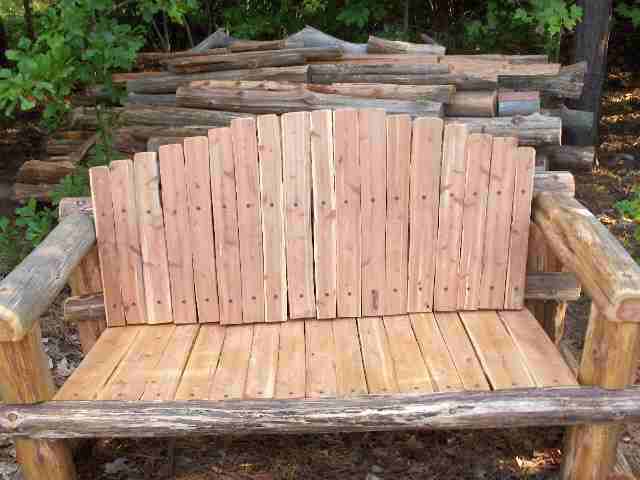
The photograph shows the second rustic cedar bench I built, which is slightly easier to construct. This was made in 2004 for our backyard after my wife had often mentioned, "Why don't we have a bench like the one in the cemetery in our backyard?" Some of my rescued cedar logs are in the background. Since then I have made two additional benches for clients following this design.
The "design" document is more a set of photos and text showing components and suggestions related to construction. For the bench I used Eastern Red Cedar tree trunks. Other species of cedar would be appropriate as well. I really don't know of any commercial sources of such wood. During home site clearing here I was always on the look out for dead cedar trees. All you really want is the red heartwood, with that beautiful smell. Over a few years I collected a fair amount but our development is now completed.
For this small bench, the seating area is comfortable for two at about 44" wide, you need the following type wood:
I use a small chain saw to cut the legs, arms, braces, seat and back supports. For the seat and back pieces I split the smaller diameter wood with a circular saw that has a maximum cut depth of 2 1/4". I use a handsaw and chisels for making the notches and also to finish the splitting, if necessary. Finally, one back support needs a tenon and mortise fit that I constructed using hole saws and a good hand drill. So some of the work is ugly in comparison to my usual woodworking efforts. But that is one of the things that make it "fun" to construct. If my method to split logs for the seat and back slats appears too complex or dangerous, commercial Western Cedar boards could be used.
The rough plan drawings and photos have comments that give you some indication of how I constructed the bench. However, the information is more a guide then a detailed plan. Since each raw log is different and you want to preserve any unique trunk character, there is no right or wrong way to cut the wood. Look closely at the left arm piece in the photo above, it had some wonderful dimples that I preserved and positioned so that you can feel that area as you sit on the bench. I also try to preserve any lichen that might be on the logs.
To view the Rustic Cedar Bench document click on the link below. The PDF file many take a few seconds to start to appear.
Free Rustic Cedar Bench Plans in a PDF format.
The Adobe Reader interface allows you to print or save it to your system. If you do not have the free Adobe Reader on your computer you will need to download it from another site.